| Pages in topic: [1 2 3] > | Off topic: I need to go to the loo/toilet Thread poster: Claudia Mattiozzi
|
|---|
Hi! In Italy, at elementary school, my daughter has been taught by her English teacher (who is Italian) to ask "Can I go to the loo?".
Personally, I don't go crazy for this word.
It sounds a bit unpolite to me. Am I wrong?
I'm wondering why the teacher does not prefer "toilet".
I'd appreciate British and American native comments. Thanks
| | | | Nicole Schnell 
United States
Local time: 06:19
English to German
+ ...
In memoriam
say: "I need to go to the bathroom." Mentioning the device/throne itself ("toilet") is considered impolite. The term "bathroom" always struck me as an odd expression, though, because the pretty much last thing that one is planning to do in a stall is taking a bath. 
| | | | Sheila Wilson
Spain
Local time: 14:19
Member (2007)
English
+ ...
use loo quite widely informal situations but I think toilet is safer for more formal occasions and when in an "international" environment - you want to be understood, after all!
Loo used to be considered "slang" (I remember being told off for using it when I first heard it) but I think it has become mainstream British English for all situations that aren't formal.
| | | | LEXpert
United States
Local time: 08:19
Member (2008)
Croatian to English
+ ...
I prefer "May/can I go to/use the restroom?", particularly if the location is any public facility. In addition, it eliminates any confusion regarding whether one is actually planning to "bathe" in the bathroom.
| | |
|
|
|
Nicole Schnell
United States
Local time: 06:19
English to German
+ ...
In memoriam | That's another beautiful unisex term | Nov 14, 2010 |
Rudolf Vedo CT wrote:
I prefer "May/can I go to/use the restroom?", particularly if the location is any public facility. In addition, it eliminates any confusion regarding whether one is actually planning to "bathe" in the bathroom.
I do love the euphemistically used term "powder room". For ladies.
| | | | | Remember we are talking about children | Nov 14, 2010 |
I don't expect formal expression by children, anyway, I believe the teacher should not teach "slang" words.
What happens if someone asks for the loo in the US?
| | | | | Lingustiic maze | Nov 14, 2010 |
I could probably give you various pages on this subject. In the UK we would quickly find ourselves mired in questions of language as an indicator of class, and "toilet" seems to have been settled on as a compromise, not completely satisfactory, but for want of anything else.
However, we have yet to find anything to satisfy both sides of the Atlantic, so students may have to learn two forms: we have long had to teach double forms (sidewalk/pavement, cheque/bill, bill/note etc).
... See more I could probably give you various pages on this subject. In the UK we would quickly find ourselves mired in questions of language as an indicator of class, and "toilet" seems to have been settled on as a compromise, not completely satisfactory, but for want of anything else.
However, we have yet to find anything to satisfy both sides of the Atlantic, so students may have to learn two forms: we have long had to teach double forms (sidewalk/pavement, cheque/bill, bill/note etc).
But Claudia, your daughter is being taught a term (loo) which is perfectly acceptable in the UK, so don't worry. ▲ Collapse
| | | | Nicole Schnell
United States
Local time: 06:19
English to German
+ ...
In memoriam | Clarification | Nov 14, 2010 |
Claudia Mattiozzi wrote:
I don't expect formal expression by children, anyway, I believe the teacher should not teach "slang" words.
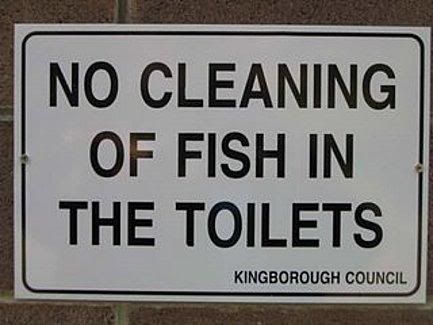
The question is not slang or no slang, in the US "toilet" simply refers to the porcellain thing only, not to the location where to find them.
Which is why signs like this (this one is from Australia, I think) are considered hilarious in the US and are listed on "Funny Signs" websites:
| | |
|
|
|
| rest room, ladies room, mens room | Nov 14, 2010 |
In the U.S., in my experience, the usual term is rest room or ladies or mens room. Nicole's comment about not mentioning the toilet rings true.
Bathroom is used, but always sounds very odd when using a public facility which has no bath.
| | | | Evans (X)
Local time: 14:19
Spanish to English
+ ...
| changing fashions | Nov 14, 2010 |
When I was at school in the UK, admittedly rather a long time ago, we were told to put up our hands and say "please may I be excused?"
"being excused" came to mean "having a pee" for a long time after that.
Certainly in the UK, "going to the loo" cuts across most class and age barriers nowadays.
[Edited at 2010-11-14 16:44 GMT]
| | | | Jessica Noyes
United States
Local time: 09:19
Member
Spanish to English
+ ...
| Relationships with teachers | Nov 14, 2010 |
Stephanie Ezrol wrote:
In the U.S., in my experience, the usual term is rest room or ladies or mens room. Nicole's comment about not mentioning the toilet rings true.
Bathroom is used, but always sounds very odd when using a public facility which has no bath.
I agree with Stephanie about the U.S., and should add that in English-speaking Canada it is usually referred to as the "washroom". To my ears, "toilet" sounds a bit stark.
As is clear from all the comments on different ways of referring to this small private space, and as we all know as linguists, language is a very fluid thing. Our children will soon come to realize this as well. When I was teaching school French, I received a courteous call from a Congolese parent informing me that I should be using "septante" instead of "soixante-dix"! Another parent from France object to my Quebec-oriented (and correct) pronunciation of certain words, even though the school itself was located near the Quebec border.
I did welcome these discussions with the native-language speaking parents, as long as their children were taught to respect the teachers (even non-native ones such as I was), to have an open mind, and to take delight in the many many ways the same idea can be expressed.
| | | | Sheila Wilson
Spain
Local time: 14:19
Member (2007)
English
+ ...
Gilla Evans wrote:
When I was at school in the UK, admittedly rather a long time ago, we were told to put up our hands and say "please may I be excused?"
My memory needed the nudge - it was so long ago - but you're right, that is what we said at school.
My Mum used to talk about "spending a penny" but I think it's more like 50 now, isn't it?
| | |
|
|
|
Definitely "toilet" for schoolchildren in UK. More polite than "loo".
By the way, if you asked a teacher in UK "Can I go to the toilet?" you would invariably get the reply:
"Yes, I'm sure you can go to the toilet (indicating ability), but I think you mean 'May I go to the toilet' (indicating permission)".
| | | | Sonia Hill
United Kingdom
Local time: 14:19
Italian to English
| Exactly what I was going to say | Nov 14, 2010 |
Catherine Gilsenan wrote:
Definitely "toilet" for schoolchildren in UK. More polite than "loo".
By the way, if you asked a teacher in UK "Can I go to the toilet?" you would invariably get the reply:
"Yes, I'm sure you can go to the toilet (indicating ability), but I think you mean 'May I go to the toilet' (indicating permission)".
I remember teachers responding in exactly that way when children asked "Can I go to the toilet"
These days I think "toilet" and "loo" are fairly interchangeable in more informal situations in the UK. However, at school we always used the word "toilet". My 3-year-old talks about "going to the toilet" at preschool, so I assume that's the term they use too. I would never say "washroom", "rest room" or "powder room", although I do sometimes say I'm going to the "bathroom".
I had assumed "toilet" was acceptable on both sides of the Atlantic, but from reading this thread I'm clearly wrong!
[Edited at 2010-11-14 19:35 GMT]
| | | | Helen Shiner
United Kingdom
Local time: 14:19
German to English
+ ...
| | Pages in topic: [1 2 3] > | To report site rules violations or get help, contact a site moderator: You can also contact site staff by submitting a support request » I need to go to the loo/toilet | Anycount & Translation Office 3000 | Translation Office 3000
Translation Office 3000 is an advanced accounting tool for freelance translators and small agencies. TO3000 easily and seamlessly integrates with the business life of professional freelance translators.
More info » |
| | TM-Town | Manage your TMs and Terms ... and boost your translation business
Are you ready for something fresh in the industry? TM-Town is a unique new site for you -- the freelance translator -- to store, manage and share translation memories (TMs) and glossaries...and potentially meet new clients on the basis of your prior work.
More info » |
|
| | | | X Sign in to your ProZ.com account... | | | | | |













 Login to reply/comment
