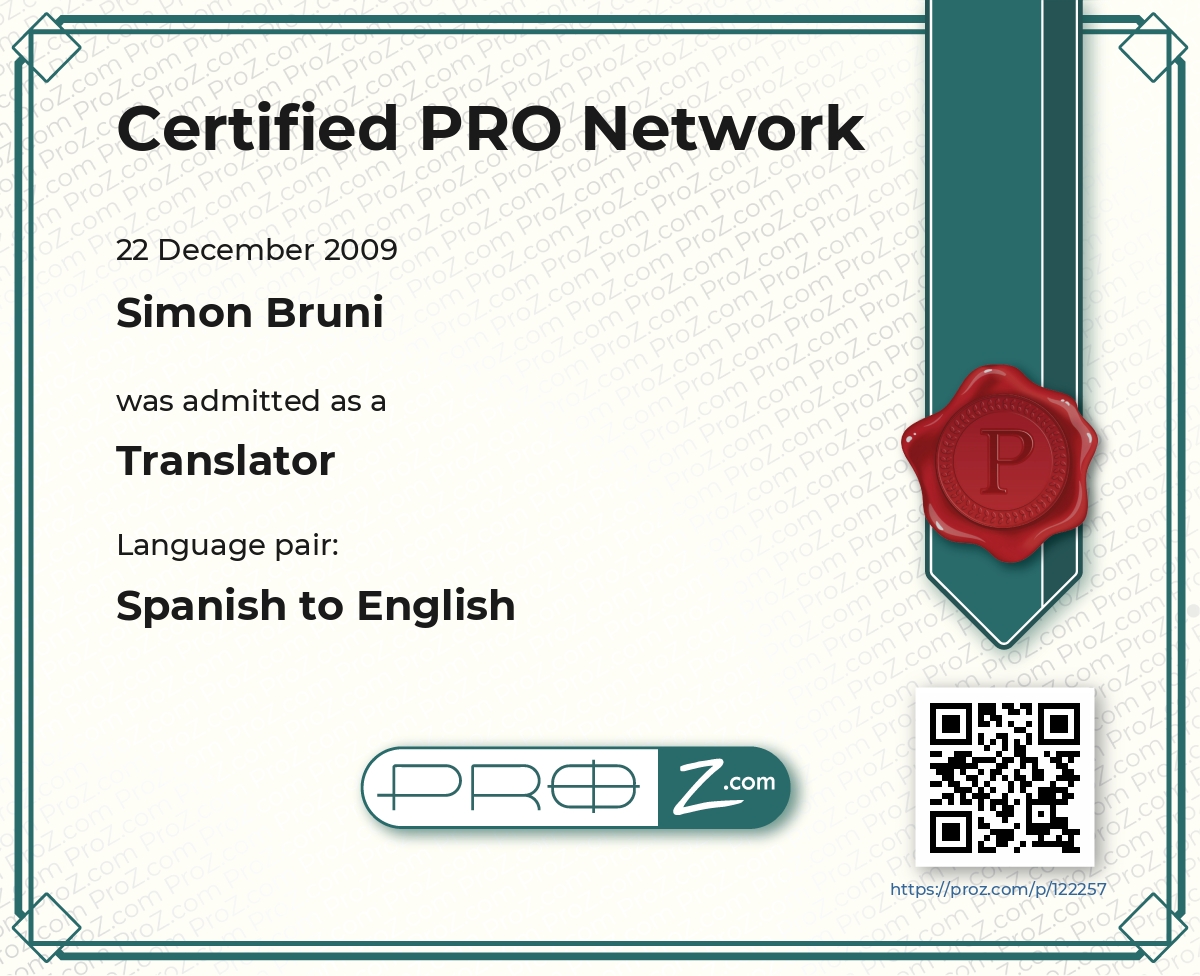
Member since Jun '09 Working languages: Spanish to English |  Simon Bruni MA, MCIL, John Dryden prizewinner Exeter, England, United Kingdom Local time: 03:37 GMT (GMT+0)
Native in: English | | |
Freelancer, Verified member | | Translation, Editing/proofreading, Transcription | | Specializes in: | | Social Science, Sociology, Ethics, etc. | History | | Slang | Sports / Fitness / Recreation | | Other | Journalism | | Poetry & Literature | Business/Commerce (general) | | Management | Tourism & Travel |
| Also works in: | | Education / Pedagogy | Environment & Ecology | | General / Conversation / Greetings / Letters | Government / Politics | | Linguistics | Idioms / Maxims / Sayings | | Certificates, Diplomas, Licenses, CVs |
More Less | | PRO-level points: 1656, Questions answered: 982, Questions asked: 567 | 0 projects entered | Sample translations submitted: 4 Spanish to English: Political commentary General field: Social Sciences Detailed field: Journalism | Source text - Spanish CUANDO DEMASIADA AUTONOMÍA ROMPE LAS NACIONES
José María Aznar
El pasado viernes 30 de septiembre el Parlamento regional de Cataluña aprobó, con la única oposición del Partido Popular, un proyecto de nuevo Estatuto de autonomía. En él se define a Cataluña como una nación, distinta de la española. Se diseña una especie de relación confederal entre Cataluña y el resto de España. Prácticamente se vacían las competencias de la Administración del Estado en la región. También se define un modelo de financiación según el cual el gobierno regional recaudaría la totalidad de los impuestos, así como un sistema judicial independiente.
Para alguien que no esté informado en detalle de la vida política española, semejante golpe a la misma base de la Constitución española –es decir, la soberanía– sólo podría explicarse por una intensa y reiterada demanda de los ciudadanos de Cataluña. No parece que tal demanda haya existido. Cada vez que han sido consultados, los ciudadanos catalanes han manifestado un notorio desinterés por la reforma del Estatuto, y han soportado una enorme presión del gobierno regional y de los partidos que lo sustentan. Más bien parece que las decisiones se han tomado de espaldas a los ciudadanos, sin mandato ni consentimiento.
Un observador italiano podría creer que la demanda independentista proviene de algún tipo de avance electoral de los partidos nacionalistas catalanes. Sin embargo, ésta es una impresión engañosa. La proporción entre partidos de implantación nacional y partidos locales en Cataluña no ha cambiado sustancialmente en los últimos diez años. Y en el Congreso de los Diputados del Parlamento español la suma de los dos grandes partidos (PSOE y PP) es la mayor desde las primeras elecciones democráticas de 1977. ¿Qué ha cambiado entonces para que se cuestione de manera tan brutal tanto la realidad nacional española como el propio Estado? Sólo ha cambiado una cosa: la actitud de la izquierda.
Es evidente que la izquierda europea lleva años en búsqueda de referentes ideológicos tras el fracaso tanto del socialismo real como de las líneas básicas de la socialdemocracia. Perdidas las bases que han guiado sus políticas durante un siglo, distintos partidos en distintos países han seguido líneas diferentes. En algunos países han sido partidos socialistas quienes han capitaneado reformas drásticas del estado del bienestar, precisamente para salvarlo y hacerlo viable. Algunos partidos socialdemócratas han sido los campeones del atlantismo. En otros casos, partidos de izquierda han impulsado reformas educativas basadas en el mérito y esfuerzo individual tras las fracasadas experiencias de los sistemas igualitaristas.
Lamentablemente en mi país la izquierda ha seguido otros derroteros. Tras su llegada al gobierno el pasado año se marcaron una línea en primer lugar destructiva. Fue el caso de la paralización de la reforma de la educación, de la anulación de un plan vital para España como era el Plan Hidrológico Nacional o de la retirada de las tropas de Irak. La siguiente fase fue más allá. Consistió en poner sobre la mesa proyectos divisivos. Se trataba de dibujar una franja lo más gruesa posible que separara lo supuestamente progresista de lo supuestamente anticuado. Daba igual que una mayoría social no compartiera esos proyectos divisivos. El objetivo era dejar fuera del sistema a todos aquellos que no compartieran las alteraciones introducidas por el Gobierno. Así se explican los ataques gratuitos e innecesarios a la Iglesia católica. Así se explican leyes como la que incluye en el concepto de matrimonio a la unión entre personas del mismo sexo, incluida la posibilidad de adopción. Así, en parte también, puede explicarse la propuesta presentada por el Gobierno en el Parlamento, que suponía una oferta de negociación a los terroristas de ETA.
Pero lo que sin duda debe de resultar más incomprensible para un observador no familiarizado con la vida política española es que el gobierno de una de las naciones más antiguas de Europa promueva su autodisolución.
Cuando el actual Presidente del Gobierno de España era líder de la oposición, afirmó en un mitin electoral, que apoyaría cualquier proyecto de nuevo estatuto de autonomía que aprobara el Parlamento de Cataluña. Si los nacionalistas presentes en el Parlamento regional necesitaban algún estímulo para enviar a Madrid un estatuto de reivindicaciones máximas, lo encontraron aquella noche.
De esta manera, el texto que ya ha entrado en el Congreso de los Diputados supone una derogación de facto de la Constitución. No sólo porque altera de modo sustancial el nivel de competencias del propio Estado y la relación de éste con las instituciones regionales, sino sobre todo porque suprime el mismo sujeto constituyente, titular de la soberanía, la nación española formada por todos los ciudadanos y que es, por definición, indivisible. La idea de una nación de ciudadanos libres e iguales ante la ley sencillamente desaparece.
Una reforma constitucional es algo que afecta a todos los ciudadanos del país. Todos los españoles deberían tener derecho a opinar y votar sobre un nuevo régimen que quiere implantarse. Pero la coalición de la izquierda y los nacionalistas no quieren permitirlo. En lugar de llevar a la Cámara un proyecto de reforma constitucional, que requiere una mayoría parlamentaria muy amplia y un referéndum nacional, han presentado un proyecto de reforma de un Estatuto regional, que puede ser aprobado por una mayoría parlamentaria ordinaria y en el que sólo los ciudadanos catalanes son consultados. Es un fraude muy grave, que elimina el derecho de todos los españoles a opinar sobre su futuro común.
El Gobierno podría impugnar ya el texto aprobado por el Parlamento de Cataluña y suspender su tramitación hasta que se pronuncie el Tribunal Constitucional. No hemos recibido hasta ahora la menor señal de que vaya a hacerlo. Igualmente, la mesa del Congreso de los Diputados podría devolverlo a Barcelona por no ajustarse su contenido a lo que debe ser un proyecto de estatuto y pedir a la Cámara regional que lo tramite como proyecto de reforma constitucional. El partido socialista ya ha anunciado que desea su trámite en el Congreso para eliminar los rasgos anticonstitucionales. Esa es una táctica engañosa. El problema no es que en el texto haya algunos rasgos inconstitucionales. El problema es que la anticonstitucionalidad viene de raíz e impregna la totalidad de su articulado.
En 1977, con las primeras elecciones democráticas tras el fin de la dictadura franquista, y en 1978, con la aprobación de la primera Constitución española fruto del más amplio consenso de las fuerzas políticas, los españoles decidimos avanzar hacia la libertad, la prosperidad y el progreso. Aquel proceso histórico pudo tener sus fallos, pero nacía de la firme y clara voluntad de aprender de nuestro pasado para no volver a cometer los mismos errores. La izquierda de aquel momento, y también el nacionalismo catalán, se implicaron, de manera correcta, en la transición democrática.
Siempre he creído en las posibilidades de España para ser uno de los mejores países del mundo. Siempre he creído que bastaba con trabajar duro y permanecer unidos en lo esencial, en la estabilidad institucional y democrática. Hoy, con la más honda preocupación, sólo puedo esperar que la voz de la mayoría obligue al Gobierno a retirar un proyecto que significa la división irreversible de España.
| Translation - English WHEN TOO MUCH AUTONOMY SPLITS NATIONS
José María Aznar
On September 30, Catalonia’s regional government, opposed only by the Popular Party, approved plans for a new statute of autonomy. This statute defines Catalonia as a nation, distinct from Spain, by designing a kind of confederal relationship between the Catalan region and the rest of the country. The state administration has been practically stripped of any jurisdiction in the region. It also establishes a financing model according to which the regional government would collect all taxes, and proposes an independent judicial system.
To anyone not well-versed in Spanish political life, such a blow to the foundations of the Spanish Constitution, namely the sovereignty of the state itself, could only be explained by intense and repeated demands from the people of Catalonia. These demands do not appear to have existed. Every time they have been consulted, the Catalan people have expressed a marked lack of interest in the reform of the statute and have withstood enormous pressure from the regional government and its political parties. Instead it looks like the decisions have been taken behind their backs, without their mandate or consent.
A British observer might well believe that the demand for independence comes from some kind of electoral success among the Catalan nationalist parties. But this is a false impression. The proportion of nationally established parties to local parties in Catalonia has not changed substantially in the last ten years. In the Spanish Parliament’s Congress of Deputies, the total number of seats held by the two main parties (the PSOE and the PP) is the highest it has ever been since the first democratic elections of 1977. So what has changed in order for the reality of the Spanish nation and the state itself to be brought so cruelly into question? Only one thing has shifted: the attitude of the Left.
It is clear that the European Left has for years been searching for ideological models following the failure both of real socialism and the basic principles of social democracy. Having lost the foundations that have underpinned their policies for a century, a variety of parties in various countries have followed a different line. In some places it has been socialist parties that have spearheaded drastic reforms of the welfare state, precisely to save it and make it viable. Some social democratic parties have been champions of NATOism. In other cases, leftwing parties have instigated educational reforms based on individual merit and effort following the failed experiences of the egalitarian systems.
Regrettably, in my country the Left has gone in another direction. When they came into office last year, they established a destructive pattern from the beginning. This included bringing to a halt the reform of the education system, abolishing Spain’s vital National Hydrological Plan and withdrawing the troops from Iraq. The next phase went even further. It consisted of placing divisive projects on the table. The aim was to open as wide a gulf as possible to separate the supposedly progressive from the supposedly antiquated. It mattered not that the social majority did not agree with these divisive projects. The goal was to leave anyone who did not approve of the changes introduced by the government out of the frame. This explains the gratuitous and unnecessary attacks on the Catholic Church. It explains laws like the one that includes the union between two people of the same sex under the concept of marriage, with the possibility of adoption thrown in. It also explains, in part, the proposal put forward by the government in parliament, which amounted to an offer to negotiate with the ETA terrorists.
But the thing that must undoubtedly be harder to understand for an observer unfamiliar with Spanish political life is that the government of one of the oldest nations of Europe should promote self-dissolution.
When the current Spanish Prime Minister was the leader of the opposition, he declared in an electoral rally that he would support any plans approved by the Catalan Parliament for a new statute of autonomy. If the nationalists present in the regional parliament needed any more encouragement to send to Madrid a statute of extreme demands, it was given to them that night.
Accordingly, the text they submitted to the Congress of Deputies amounts to a de facto revocation of the constitution, not just because it significantly alters the level of jurisdiction of the state itself and its relationship with the regional institutions, but above all because it cuts out the constituent power itself, the holder of sovereignty, namely the Spanish nation, made up of all of Spain’s citizens and therefore, by definition, indivisible. The idea of a nation’s people free and equal in the eyes of the law goes out of the window.
Constitutional reform is something that affects all of a country’s citizens. All Spaniards should have the right to express an opinion and vote on any desired new system. But the coalition between the Left and the nationalists does not want to allow it. Instead of putting forward in Parliament plans for constitutional reform requiring a very large parliamentary majority and a national referendum, they have presented plans for a regional statute reform, to be approved by an ordinary parliamentary majority and on which only the Catalan people are consulted. This is a very serious deception which denies the people of Spain their right to express an opinion on their common future.
The Government could now challenge the text approved by the Catalan Parliament and postpone the process until the Constitutional Court makes a decision. To date we have not received the slightest indication that they will do so. Equally, the Congress of Deputies committee could send it back to Barcelona on the basis that its content is not in keeping with what a statue plan should be, asking the regional chamber to process it as a plan for constitutional reform. The socialist party has already announced that it wishes the statute to be processed in Congress in order to eliminate its anti-constitutional elements. This is a deceptive ploy. The problem is not that there are unconstitutional aspects to the text. The problem is that at the root of it lies an anti-constitutionality that permeates all of the statute’s articles.
In 1977, on the occasion of the first democratic elections following the end of the Franco dictatorship, and then in 1978, when a sweeping consensus among political forces approved the first Spanish Constitution, the people of Spain decided to advance towards freedom, prosperity and progress. That historical process may have had its faults, but it was born of a firm and forthright desire to learn from our past so that we do not make the same mistakes again. The Left at that time, and the Catalan nationalists too, involved themselves in the proper manner in the transition to democracy.
I have always believed in Spain’s potential to be one of the best countries in the world. I have always believed that all we had to do was work hard and remain united on the essentials, on institutional and democratic stability. Now, with the deepest concern, I can only hope that the voice of the majority will force the Government to withdraw a plan that will mean an irreversible division of Spain.
| Spanish to English: A Spanish ballad General field: Art/Literary Detailed field: Poetry & Literature | Source text - Spanish “Caballero de lejas tierras,
llegáos acá y paréis,
hinquedes la lanza en tierra,
vuestro caballo arrendéis;
preguntaros he por nuevas;
si mi marido conocéis?”
“Vuestro marido, Señora,
decid de qué señas es.”
“Mi marido es mozo y blanco,
gentil hombre y bien cortés,
muy gran jugador de tablas
y también del ajedrez.
En el pomo de su espada
armas trae de un marqués,
y un ropón de brocado
y de carmesí el envés.
Cabe el fierro de la lanza
trae un pendón portugués,
que ganó en unas justas
a un valiente francés.”
“Por esas señas, Señora,
tu marido muerto es.
En Valencia le mataron,
en casa de un ginovés,
sobre el juego de las tablas
lo matara un milanés;
muchas damas lo lloraban,
caballeros con arnés,
sobre todo lo lloraba
la hija del ginovés.
Todos dicen a una voz
que su enamorada es.
Si habéis de tomar amores,
por otro a mí no dejéis.”
“No me lo mandéis, Señor,
señor, no me lo mandéis,
que antes que eso hiciese,
Señor, monja me veréis.”
“No os metáis monja, Señora,
pues que hacerlo no podéis,
¡que vuestro marido amado
delante de vos lo tenéis!”
| Translation - English “Oh knight from lands afar,
do stop, for rest you need,
more, set aside your lance
and tether up your steed;
Pray tell if you bear news
of the man I long to see.”
“This man of whom you speak,
of what countenance is he?”
“My husband’s young and handsome,
a noble, one can tell,
a skilful player of games
of chess and draughts as well.
The pommel of his sword,
a marquis’ arms it bears,
a robe of fine brocade
and of crimson silk he wears.
His lance’s shaft displays
a Galician standard gained
defeating gallant Frenchmen
who in tourney he restrained.”
“From what you say, my Lady,
departed is your spouse,
murdered in Valencia
at a man from Genoa’s house.
‘twas o’er a game of draughts and
his killer Milanese;
so many damsels mourned him
and knights were ill at ease.
And most of all the daughter
of the house where it took place,
did sorely miss your husband
much to everyone’s disgrace.
If you require a lover,
then please consider me,
for I am good and knightly,
as chivalrous as he.”
“My Lord do not enjoin me,
I will not be enticed,
I assure you I would sooner
become a bride of Christ.”
“Do not become a nun,
nay you cannot take that vow,
for your beloved husband
is here before you now!”
| Spanish to English: Extract from the novel 'Si te dicen que caí' General field: Art/Literary Detailed field: Poetry & Literature | Source text - Spanish Se cruzó con el doctor Albiol en el pasillo y desenfundó rápido y disparó, ligeramente inclinado sobre el costado derecho. El doctor se reía y lo paró, tú siempre de broma, Ñito, qué haríamos sin ti en este hospital, ofreciéndole un cigarro. Preguntó ¿qué, alguna novedad?, y el celador contestó escuetamente: esta mañana ingresaron cuatro, accidente de coche, un matrimonio y dos hijos.
__ ¿Y los parientes…?
__No tienen.
__ ¿Y tú como lo sabes?
El celador empezó a toser, tosió un rato apoyando una mano en la pared estucada. Ya sé a lo que vienes, pensó, todos sois igual. Con su pañuelo azul se limpió los labios, las cejas y la frente, y se volvió a medias de cara a la pared y congestionado para gruñir no vendrá nadie, si quiere una disección dígalo ahora, coño, qué más da otro pedazo. El doctor Albiol preguntó quién hará la autopsia, y en seguida, sin esperar respuesta, con media sonrisa crispada: pero bueno, ¿estás llorando? El celador se alejaba: ¿quién llora aquí, coño?
-Doctor, decía, acérquese, toque.
Presionando con los dedos la tensa piel del vientre, bajando, tanteando el hueso debajo de la pelvis. Hay que abrir en seguida, dijo el otro, y en sus manos Juanita notó más delicadeza, más calor y como un cariño al subirle la falda hasta la cintura. De pronto le oyó rugir: ¡Tijeras!
Echada de espaldas sobre una dura superficie que olía a madera quemada, vio la cara del doctor bajando hasta la suya con un destello de plata en los dientes. Sonrió tranquila, aunque con el pecho muy agitado, viéndole esgrimir las tijeras y mascullar las frías recomendaciones: calma, Juani, ni te vas a enterar, es como un afeitado en seco pero en seguida vuelve a crecer. ¿Quién está asustada, yo?, ella con una sonrisa que era un desafío: no me veréis llorar, jolines, no os daré ese gusto. Notó las puercas manos separando sus muslos con fuerza, los dedos demorándose en las zonas más tiernas, arriba, cerca de las ingles, el frío contacto de las tijeras y el cric-cric decapitando los rizos duros del color de la miel. Oyó decir: peluda la niña, mientras contenía la respiración, y sonrió resignada a la alta noche del verano, a las estrellas. Cayeron los últimos rizos y las manos seguían porfiando, explorando. Avisa cuando te duela, grita si quieres, nadie te va a oír. Ella se debatió furiosamente bajo la presión de las correas y pensó qué guarros, se me comen con los ojos, lo que sea que sea pronto. El doctor hablaba de úlceras y tumores malignos, y alguien dijo: Anastasia, y otro respondió anestesia, burro, y entonces ella vio caer sobre su nariz una plasta negruzca que olía a mocos. El pañuelo del Tetas mojado con agua de regaliz. Respira, tonta, te estamos anestesiando.
Juanita pataleó hasta que pudo respirar de nuevo. Quieta, chavala, y las cinco caras colgantes apretaban el cerco. Hay que explorar más, dijo el doctor, y ella cochinos, me habíais dicho que sería con guantes, protestó juntando los muslos, pero en seguida cuatro manos ansiosas volvieron a separarlos, mientras se paseaba ante sus ojos la centelleante navaja. Juanita ahogó un grito en el pecho al sentir el dedo rondando las cercanías, separando los labios, hurgando, atornillando, resbalando por las húmedas paredes. Se concentró probando a imaginar aquello, incluso cerró los ojos y soñó un peso dulce oprimiendo sus senos, sus labios, soñó un cariño por su pelo, pero no sintió nada. Al otro lado de las lágrimas, arriba en lo alto de su rabia, más allá de las ramas del almendro y de las palmeras mecidas por la brisa, el parpadeo de las estrellas enloqueció d pronto, la luz se descompuso. No te quedará señal, decía el más sobón, quieta, si no te portas bien vendrá a operarte el doctor Java y verás lo que es bueno.
Juanita consiguió levantar la cabeza y clavó sus pupilas en él.
-¡Cochino! – lanzó juntamente con el salivazo -. ¿Sarnoso de mierda!
-Ya estás avisada – dijo Sarnita con calma, limpiándose la cara con el dorso de la mano-. Así que habla, maldita, canta de plano o probarás el Hierro Candente.
-Te marcaremos como a la Mujer Marcada –amenazó el Tetas.
-¿O prefieres el boniato? –dijo Luis.
-A ésta le gusta el tomate –deslizó Martín al oído de Sarnita, los dos sujetándola por las piernas-. Vomitará todo lo que sabe, pero antes quiere probar el boniato. La puntita nada más.
-No te hagas la estrecha, Juani –decía el Tetas, Mojando de nuevo el pañuelo en el líquido negro de un botellín de vermut-. Canta y te soltaremos, no seas boba.
-¿Esto es jugar a médicos? –protestó ella -. ¿Esto? No me enredaréis más. ¿Y tú quieres ser médico cuando seas grande?
-Seré médico –dijo Sarnita-. Operador.
-Ja, ja, ¡Animal!
-¿De qué te ríes, mamona? ¡Luis, el boniato! –Ordenó Sarnita, abriendo la palma de la mano con la fulminante autoridad de un cirujano en el quirófano-. ¡Rápido!
Se acercó Luis y ella notó el olor a café tostado que desprendían sus ropas. Cerró los muslos y clausuró una vez más el dulce ensueño de aquello. Con sus rugosidades y sus pelajos, crudo y frío, puntiagudo y al mismo tiempo sobado por el roce de tantas manos y bolsillos: así lo imaginaba ahora abriéndose paso. Todas las manos no tenían sin embargo bastante fuerza para separar sus piernas, toda la diabólica habilidad de Sarnita no alcanzaba a introducir siquiera la puntita nada más. Huy, huy, hablaré, dijo Juanita con una urgencia fingida, pero soltadme, dejadme respirar...
| Translation - English He ran into Doctor Albiol in the corridor and he quick-drew and fired, leaning slightly to his right. The doctor laughed and stopped him, you’re always fooling around, Ñito, what would we do without you in this hospital, he said, offering him a cigarette. Any news? he asked, and the orderly answered tersely: this morning four were admitted, a car accident, a married couple and two children.
‘And the relatives...?’
‘They have none.’
‘How do you know?’
The orderly started to cough; he coughed for a moment, leaning with his hand against the plastered wall. I know why you're here, he thought, you’re all the same. With his blue handkerchief he wiped his lips, eyebrows and forehead, and he half-turned to the wall, his face flushed, to growl that nobody would come, and that if he wanted a dissection to say so now, what difference would another lump or two make? Doctor Albiol asked who would do the autopsy and without waiting for an answer, with a tense half-smile, he said: God, are you crying? The orderly was walking away: who’s bloody crying?
‘Doctor,’ he said, ‘come closer, touch this.’
Pressing his fingers down on the taut skin of the stomach, he moved his hand down, feeling the bone under the pelvis. We have to open her up right away, said the other, and Juanita noticed more delicacy, more warmth and something like affection as he lifted her skirt to the waist. Suddenly she heard him roar: scissors!
Flat on her back on a hard surface that smelt of burnt wood, she saw the doctor’s face coming towards hers with a silver sparkle in his teeth. She smiled calmly, but her heart pounded in her chest as she saw him brandish the scissors and mutter cold advice: calm down, Juani, you won’t notice a thing; it’s like a dry shave but it soon grows back. Scared? Who, me? She smiled defiantly: you won’t see me cry, damn it, I won’t give you the pleasure. She noticed their filthy hands pulling her thighs apart strongly, their fingers lingering in the softest areas, higher, near the groin, the cold contact of the scissors and the snip-snip as they beheaded the bristly honey-coloured curls. She heard them say: she’s hairy, this girl, as she held her breath and smiled, surrendering to the high summer night sky, to the stars. The last curls came off and the hands continued to insist, probing. Let us know when it hurts, shout if you want, nobody’s going to hear you. She struggled furiously under the pressure of the straps and thought, the filthy pigs; they're eating me with their eyes, whatever you’re doing, make it quick. The doctor talked about ulcers and malign tumours, and someone said: Anastasia, and the other responded: anaesthetic, you ass, and then she watched as a blackish mess, smelling of snot, fell onto her nose: Boobs’ handkerchief dipped in liquorice water. Breathe, you idiot, we’re anaesthetising you.
Juanita kicked her feet until she could breathe again. Stay still, girl, and the five pendulous faces closed the ring around her. We have to probe more, said the doctor; pigs, you told me it would be with gloves, she thought, clutching her thighs together in protest. But at once four eager hands opened them again as the gleaming knife was waved in front of her. Juanita stifled a cry rising in her chest as she felt a finger prowling her perimeter, parting her lips, poking, screwing, sliding along her moist walls. She concentrated, trying to picture it; she even closed her eyes and imagined a gentle pressure on her breasts, her lips. She imagined her hair being caressed lovingly. On the other side of her tears, up above her rage, beyond the branches of the almond tree and the palm trees swaying in the breeze, the twinkling stars suddenly went crazy, the light fragmenting. There won’t be a scar, said the main groper; keep still, if you don’t behave Doctor Java will come and operate on you and then you’ll find out the true meaning of pain.
Juanita managed to lift her head and riveted her eyes on him.
‘Pig!’ she let out as she spat at him. ‘You scabby piece of shit!’
‘You’ve been warned,’ said Scabious calmly, wiping his face with the back of his hand. ‘So talk, witch; spit it out or you’ll taste the Hot Poker.’
‘We’ll mark you like the Marked Woman,’ Boobs threatened.
‘Or would you prefer the sweet potato?’ said Luis.
‘This one likes tomato,’ Martín interjected into Scabious’s ear, as the two of them held her down by her legs. ‘She’ll squeal everything she knows, but first she wants to try the sweet potato. Just the tip.’
‘Don’t be such a prude, Juani,’ said Boobs, dipping his handkerchief back into the black liquid in his vermouth flask. Talk and we’ll let you go, don’t be stupid.’
‘This is what you call playing doctors and nurses?’ she protested. ‘This is it? You’re not going to drag me any further into this. And you want to be a doctor when you grow up?’
‘I will be a doctor,’ said Scabious. ‘A surgeon.’
‘Ha ha, animal!’
‘What are you laughing at, bitch? Luis, the sweet potato!’ Scabious ordered, opening the palm of his hand with the resounding authority of a surgeon in theatre. ‘Quickly!’
Luis came close and she noticed the smell of roasted coffee given off by his clothes. She squeezed her thighs together and brought to a close her sweet daydream. With its lumpy and hairy skin, raw and cold, pointed and yet worn by the rubbing of so many hands and pockets: that’s how she imagined it now, pushing its way through. All of those hands, however, had not the strength to pull apart her legs, and for all of Scabious’s devilish skill he could insert nothing more than the very tip. Aargh, I’ll talk, said Juanita with feigned urgency, but let me go, let me breathe…
| Spanish to English: Local newspaper article, politics General field: Social Sciences Detailed field: Journalism | Source text - Spanish El Ayuntamiento de San Roque cambia de ubicación
San Roque celebró el Día de la Constitución con dos inauguraciones muy importantes, la de la Plaza de las Constituciones y la de su nueva Casa Consistorial en el edificio Diego Salinas.
Durante el acto, tomaron la palabra los portavoces de todos los grupos municipales y la concejal no adscrita. El representante del PP, José Antonio Cabrera, hizo un recordatorio de la historia de la antigua Casa Consistorial y tuvo un recuerdo para el anterior alcalde, el fallecido José Vázquez, quien fue el que ordenó el inicio de la restauración del edificio que a partir de hoy alberga las oficinas municipales. En su opinión, las nuevas instalaciones son “el gran proyecto del siglo XXI” del Ayuntamiento, que se ha iniciado “con la única intención de prestar los mejores servicios posibles a los ciudadanos”.
Juan Carlos Ruiz Boix, portavoz del PSOE ensalzó la proclamación de la actual Ley de Leyes como “un acto de generosidad y renuncia de todos, por alcanzar el consenso”. Aunque habló de varios derechos y libertades, se detuvo en el Derecho a la Huelga, y apeló al Equipo de Gobierno para que mediara en el conflicto de Arquitempo. Seguidamente intervino el portavoz de USR, José Antonio Ledesma, quien recordó algunas de las utilidades del edificio Diego salinas. Para Ledesma, “esas paredes están llenas de historias personales”. Finalizó pidiendo a la Junta de Andalucía que admita la petición municipal de recuperar el Pabellón C del Complejo Diego Salinas, el único que falta por rehabilitar.
El portavoz del PIVG, Jesús Mayoral, improvisó un discurso en el que arremetió contra los estatutos “que están atacando la Constitución”, a la que definió como “el marco de convivencia que nos hemos dado los españoles”.
Por su parte, el concejal del PA Manuel Melero señaló que “la Casa Consistorial resume los anhelos pero también las frustraciones de un pueblo”, y dedicó un tiempo a recordar “a todos los regidores del periodo democrático”, en especial a los que permanecieron en el edificio el 23 de febrero de 1981.
A continuación, tomó la palabra la concejal no adscrita Rosa Macías, quien reivindicó su “condición de mujer socialista” y también los derechos y libertades, empezando por el derecho a votar y a ser elegidas en unas elecciones, que ampara la Constitución de 1978. Recordó a José Vázquez, al que calificó de “ser humano con mayúsculas”. Sus palabras fueron recibidas con gritos críticos de parte del público asistente.
El alcalde, Fernando Palma, cerró el acto con una breve intervención donde expresó su deseo de que “nosotros y nuestros sucesores llevemos el pueblo a buen puerto desde la nueva Casa Consistorial, una Casa Consistorial del siglo XXI que se asienta en el mejor lugar, en un lugar lleno de historia”.
Críticas
Durante el acto, no todos fueron momentos de celebración, en el mismo hicieron acto de presencia trabajadoras de la empresa Arquitempo junto a sus familiares, que portaron pancartas de protesta y protestaron tras algunos de los discursos de los ediles.
También el portavoz del PIVG fue crítico con la inauguración de esta nueva Casa Consistorial, indicando que su partido y simpatizantes “no ponemos pegas a un gran edificio municipal, pero reivindicamos que se acerquen los servicios municipales a todos los distritos, no sólo los cargos políticos, sino que también se lleven allí edificios, medios materiales y humanos”.
El PSOE destacó que la inauguración del nuevo Ayuntamiento fue un momento agridulce al recordar a los alumnos y monitores de la Universidad Popular que inicialmente iban a disfrutar de una inigualable sede, rehabilitada pensando en ellos.
Además, los socialistas denunciaron que tras el acto se ofreciera una copa para 200 personas, “cuando el Ayuntamiento siempre está “llorando” por la delicada situación de las arcas municipales.
| Translation - English San Roque Town Hall moves to new premises
San Roque celebrated Constitution Day with two very important inaugurations: Plaza de las Constituciones and the new town hall in the Diego Salinas building.
During the ceremony there were speeches from spokespeople for all of the municipal groups and from the only unaffiliated councillor. The PP representative, José Antonio Cabrera, recalled the history of the old town hall and remembered the previous mayor, the late José Vázquez, who was the person who initially ordered the refurbishment of the building that will now house the municipal offices. In his view, the new premises are the municipal council’s “big project of the 21st Century”, initiated with the “sole intention of providing the best possible services to the public”.
Juan Carlos Ruiz Boix, the PSOE spokesman, sung the praises of the current Law of Laws as “an act of generosity and self-sacrifice by everyone to reach a consensus”. Although he talked about various rights and liberties, he dwelled on the Right to Strike and appealed to the governing body to mediate in the Arquitempo dispute. The USR spokesman, José Antonio Ledesma, then weighed in, pointing out some of the helpful features of the Diego Salinas building. For Ledesma, “these walls are crammed with personal stories”. He ended by urging the Andalusian Regional Government to accept the municipal request to recover Block C of the Diego Salinas complex, the only one still pending refurbishment.
The PIVG spokesman, Jesús Mayoral, improvised a speech in which he laid into the statutes “that are attacking the Constitution”, which he defined as “the framework for coexistence that we Spaniards have given ourselves”.
The PA councillor, Manuel Melero, indicated that “the town hall encapsulates the desires but also the frustrations of the people”, and he commemorated “all councillors of the democratic era”, in particular those who remained in the building on February 23, 1981 (the day of Spain's military coup).
The unaffiliated councillor, Rosa Macías, then took the floor, laying claim to her “status as a socialist woman” and also her rights and liberties, starting with the right to vote and to be elected, under the protection of the 1978 Constitution. She commemorated José Vázquez, who she described as a “first-class human being”. Her words were received with shouts of criticism from some members of the public in attendance.
The mayor, Fernando Palma, brought the ceremony to a close with a brief speech in which he expressed his desire for “us and our successors to take the people in the right direction from our new town hall, a 21st-Century town hall in the best location, a place full of history”.
Criticism
The ceremony was not all celebrations: the event was attended by workers of the Arquitempo firm alongside their families bearing placards and protesting after some of the speeches made by the councillors.
The PIVG spokesman was also critical about the inauguration of a the new town hall, indicating that his party and their supporters “do not oppose having a big municipal building, but we demand that the municipal services be brought closer to the districts, not just the political roles but also buildings, resources and staff”.
The PSOE underlined that the inauguration of the new town hall was a bittersweet moment given that the students and supervisors of the Popular University were initially going to be the ones that would benefit from some unbeatable premises, refurbished with them in mind.
The socialists also condemned the fact that drinks for 200 people were being offered following the ceremony, “when the municipal council is always bemoaning the delicate situation of the municipal coffers”.
| More Less | Building, business & marketing, electrical, food & drink, general, History, Idioms, industry, IT and Comms, Legal, Nature, Old / Golden Age Spanish, Politics, sports, tourism More Less | | Master's degree - Exeter University | | Years of translation experience: 7. Registered at ProZ.com: Oct 2005. Became a member: Jun 2009. | | Spanish to English (Exeter University, verified) Spanish to English (Queen Mary College, University of London, verified) | | IOL | | Adobe Acrobat, Microsoft Excel, Microsoft Word, MS Excel (advanced user), Powerpoint, SDL TRADOS | | http://www.simonbruni.com | | English (PDF), Spanish (PDF) | | Conference attended | | Simon Bruni endorses ProZ.com's Professional Guidelines. | | About me 
Seven years' experience as a professional translator
MA in Literary Translation (Distinction)
BA in Spanish and Linguistics
Member of the Chartered Institute of Linguists
Over four million words translated professionally
Six years living, studying and working in Spain
Third prize in the John Dryden Competition for unpublished literary translations
I am an utterly committed and ambitious translator. I have a solid grounding in my source language, in linguistics and in the multi-disciplinary field of translation studies via my MA in Literary Translation (University of Exeter) with Distinction and my BA (Hons) in Spanish and Linguistics (University of London), as well as a total of six years living, working and studying in Spain, completely immersed in Spanish life.
I have been a professional translator for seven years and in my six years as a freelance professional I have translated over four million words from Spanish into perfect English for satisfied clients.
Specialist fields: Journalism (news and magazine articles), literature, Golden Age Spanish and old texts, academic writing, management (public and private sector), business and marketing, culture (including history, humanities and the arts) and tourism.
I am currently seeking a publisher for my translation of the novel Celda 211 by Francisco Pérez Gandul, for which I won third prize in the John Dryden Translation Competition.
Testimonials:
Mr Bruni took a seventeenth-century text that was filled with archaic tenses, vocabulary and phraseology, and was almost devoid of punctuation, and tranformed it into lucid, graceful prose. I couldn't be more pleased with the translation.
(On my translation of Celda 211): ... an outstanding piece of work... not only a translation of professional quality, but of high professional quality at that.
Please do not hesitate to contact me if you have any questions or require my services
Visits:
 HIT COUNTER
 | This user has earned KudoZ points by helping other translators with PRO-level terms. Click point total(s) to see term translations provided.
|
| Keywords: spanish to english translator, traductor de español a inglés, spain, spanish, english, translator, linguist, english native, gastronomy, editorial, freelance, food, culinary, cooking, tourism, marketing, business, translator, traductor, gastronomía, restaurante, carta, alimentación, santander, marketing, turismo, español, inglés, journalism, literary, poetry, fiction, literario, especialista, specialist, turismo, periodismo, periódicos, newspapers, revistas, magazines, reviews, cultura, culture, nativo, británico, literature, literatura, business, empresa, website, websites, páginas Web, sitios Web, cantabria, novel, novela, Cell 211, Celda 211, academic, académico, history, historia, humanities, humanidades, golden age, siglo de oro
Profile last updated Jan 20 |