This site uses cookies.
Some of these cookies are essential to the operation of the site,
while others help to improve your experience by providing insights into how the site is being used.
For more information, please see the ProZ.com privacy policy.
VIA AILooking for an interpreter?
Remoto by ProZ.com connects you with an identity-verified interpreter by video or phone in about 60 seconds — 300+ languages, on demand or booked ahead.
Try Remoto »
Member since Jul '26
Working languages:
French to English English (monolingual) English to French French (monolingual)
Client-vendor relationship recorded successfully!
Bradley Hodges has been added to your list of hired vendors.
This person has a SecurePRO™ card. Because this person is not a ProZ.com Plus subscriber, to view his or her SecurePRO™ card you must be a ProZ.com Business member or Plus subscriber.
Affiliations
This person is not affiliated with any business or Blue Board record at ProZ.com.
Services
Translation, Editing/proofreading, Subtitling, Transcription, Interpreting, AI + Human review (MT post-editing), Copywriting, Transcreation, Linguistic validation, AI training
Expertise
Specializes in:
Linguistics
Education / Pedagogy
Law: Contract(s)
Business/Commerce (general)
Cosmetics, Beauty
Medical: Health Care
Retail
Finance (general)
Gambling/Casino/Bets
Medical: Instruments
Cinema, Film, TV, Drama
Tourism & Travel
Safety Data Sheets/Regulations
Real Estate
Nutrition
Market Research
Internet, e-Commerce
Journalism
Linguistic evaluation/cognitive debriefing
Law (general)
General / Conversation / Greetings / Letters
Idioms / Maxims / Sayings
Medical (general)
Volunteer / Pro-bono work
Open to considering volunteer work for registered non-profit organizations
English to French: What the Congress Got Right. What the Election Got Wrong. General field: Art/Literary Detailed field: Jewelry
Source text - English What the Congress Got Right. What the Election Got Wrong.
'I went to Singapore arguing the WFDB stood at a fork in the road. It chose continuity. The rest of the trade, sitting in the same room, chose something else entirely.'
By David Troostwyk
I arrived in Singapore believing that the 41st World Diamond Congress would be the moment
the World Federation of Diamond Bourses decided what it wanted to be. I said so publicly before I travelled. In "A Watershed Moment for the World Diamond Congress" I argued that the Federation stood at a fork in the road, one path leading to continuity and a slow slide into irrelevance, the other to transformation. The presidents descending on Singapore were the people who would choose. I stood for Vice President alongside Ahmed Bin Sulayem and Molefi Letsiki, because I believed that together we had what it would take to modernise and reform the organisation for today’s environment.
I still believe it was the right argument. I was simply wrong about which road would be taken.
Let me start by saying that I was wholeheartedly impressed by the Congress itself, it was one of the best industry gatherings I can remember. The election, in contrast, felt as though it was a failure of resolve. Ultimately, the decision was made to stick to the status quo, and although it seems very little changed what actually happened to get there is worth unpacking.
Before the Ballot
I thought that publishing my earlier article may cause a reaction, and indeed it did. They were manifold and numerous. The Federation itself reportedly received a number of complaints, with objections that ran roughly as follows: elections are not played out in public, the opinions of people who do not hold a vote are of no consequence, and the only legitimate interest belongs to presidents and vice presidents. Others took the opposite view, arguing that the piece generated a refreshing, genuine interest in the organisation and its proceedings. Some called it spamming, propaganda, and objected to an election discussion happening in WhatsApp groups with a large audience. This was so contentious that many proposed shifting the discussion into a newly formed, much smaller group, in the final days.
It personally felt as close to censorship as I have experienced in this industry. An eighty-year-old institution that represents a global trade should be able to withstand one of its own members writing about its future. If the argument was wrong, surely, it’s in everyone’s interests to have it corrected in the open? I was happy to give my opinion then and I am happy to give my opinion again now.
The days before the vote also brought a concerted push against Ahmed. Two arguments held court. The first was that Dubai already holds too much influence over the global diamond industry, and that electing a man who is not a diamond dealer in the traditional sense, whatever his record, would mean losing control of the organisation (never mind that he chairs the DDE, and acted as KP chair on two separate occasions and caretaker chair when no one else stood up). The second was that Dubai is too pro synthetic. Ahmed answered both arguments forcefully and publicly. His interest in synthetics, he said, is neutral and if anything, technological rather than jewellery focused. In any case, China and India are the world's largest producers and polishers of synthetic stones and the USA is the biggest consumer, simply factual. Some feel his robustness did not help him. That may be right, but it is also worth asking what it says about us when a candidate is punished for answering an attack directly.
Instead of being motivated with what lies ahead it was where we had come from which seemed to still play on people’s minds, and this was the real crux that decided where the votes were going. It wasn’t so long ago that 90% of the worlds rough travelled through Antwerp in some form. When I lived there pre-2011, it was still a destination for buyers from around the world. Buyers from the far east would open buying offices, and traders from all round the world would descend on the Diamond Capital. Today much of that lustre has gone, Dubai superseded Antwerp, in part because it was more ambitious and Antwerp was too complacent. Still fresh in the mind to many, Dubai is read as a threat, but in my view, however unfortunate it may be, that ship has sailed. Dubai has already overtaken Antwerp as the world's rough trading hub, and the sensible response now is to work with Dubai to find new opportunities for Antwerp, rather than spend energy trying to stifle its advance. It was mooted that Belgium would support Lin Qiang, given the good relationship between Belgium and China, and the obvious Belgian interest in a strong Chinese market. The politics of the vote went as thus; In order not to split the vote, Belgium appeared to have moved behind Mehul Shah, to be certain Dubai did not gain a foothold. India's calculation was similar, they did not want to cede power, or the perception of power, even though they are a much stronger industry nation (even with their healthy trading relationship with Dubai, and the fact that Indian companies use Dubai’s hub to their own advantage wherever it suits them). So, this was never really a contest of ideas or visions for the organisation itself. It was a contest of strength and ego for specific industry regions.
The Election in Detail
It was an eventful and, at moments, faintly absurd afternoon.
Despite being in 2026, the secret ballot was conducted with paper and envelopes. Technology exists that would have made the procedure cleaner, faster and far less prone to error, yet an enormous amount of organisational effort went into printing ballot papers instead. Each bourse was called in turn, and each voter stood and stated their name, their bourse and their position within it. Dignified in its way, it was a scene that would have looked familiar in 1976.
Congress elections carry a specific rule: no proxies, and only presidents and vice presidents may vote. The rule exists to ensure that presidents and vice presidents actually turn up. It became apparent during the roll call that board members from several bourses had been elevated to vice president in the days before the congress for the sole purpose of qualifying them to vote. That makes a mockery of the rule and of everyone who obeyed it.
The ballot was called for the President. Then, with the envelopes about to be opened, someone pointed out that the candidates had prepared speeches and that the room wanted to hear them. The entire first vote was voided. An election for the leadership of the global diamond trade was held, and then unheld, because we had forgotten to let the candidates speak.
The speeches, when they came, were worth hearing. Ahmed spoke about running the DMCC,
about the broader view that comes from leading a trading centre rather than a single business, about bringing all bourses together, representing all members, modernising the Federation and creating new entry points and new opportunity. Lin Qiang spoke about long experience and about working with every stakeholder for the good of the natural diamond business. Mehul Shah spoke about deep rooted experience, stable leadership, and guiding the world's bourses through changing consumer preferences, new technologies and evolving international trade conditions.
The vote was retaken. Mehul Shah was elected President, the first Indian ever to hold the office, which is a genuine milestone for the largest workforce in our industry. Ahmed and Lin were both invited to stand for Vice President and both declined. Molefi Letsiki withdrew from the Vice-Presidential race in order to stand unopposed for Treasurer General, which he duly won. Philippe Barsamian was returned as Vice President and Luigi Cosma elected Vice President for the first time. Rony Unterman was returned as Secretary General. I stood for Vice President and was not elected.
The most refreshing outcome of the day, by a distance, was Molefi Letsiki as Treasurer General, and I support him unequivocally. He is a practitioner who has built his career inside
benefaction, youth development and ethical trade rather than observing it from the outside, and he arrives in that office from the producing world, which no Treasurer General has done before. If this executive has an asset, it does not yet fully appreciate, it is him.
There was nervousness in the building beforehand, a great deal of lobbying, and a widespread sense that the result was settled before a single envelope was sealed. India represents the largest body of workers in this trade and had the most to win and the most to lose, and the leadership meant considerably more to that community than to most others in the room. I understand that entirely. Whether it served the organisation is a different question, and I suspect that for many voters it was never really asked.
The Federation had a real opportunity to elect a leadership built for the business environment that exists in 2026 rather than the one that existed in 1996, and it chose not to. What we got was the status quo, nothing refreshing, and a three year wait before the membership gets another say, most probably six before this office genuinely changes character, since a president may serve two terms. The new administration inherits an uphill battle to be more impactful than the one that has just left.
Credit where it is due, and it is due. The outgoing executive did a decent job in genuinely difficult years. They took the Federation from almost nothing in the bank to close to a million dollars, franchised out Get Diamonds, and grew the membership, including bringing producing countries inside the tent. That is a real record, and it deserves saying out loud.
Which is exactly why the conduct of the election stings. Botswana and Angola joined this Federation with real excitement about what it could become. I cannot imagine either delegation was impressed by what they watched on Monday afternoon. They came for a modern institution and were shown envelopes, hastily minted vice presidents and a vote that had to be run twice.
And then the congress began
Away from the ballot box, as I said, this was as good a congress as I have been to. Superbly
organised, warm, busy, and unified in a way that our trade has not always managed. The panels were substantive rather than promotional. If you had walked in on Tuesday morning knowing nothing of Monday afternoon, you would have concluded that this industry knows precisely what it needs to do.
There was organisational business too. The Qatar Diamond Exchange was admitted as a new
member. The Israel Diamond Exchange and the New Israel Club for Commerce rejoined, though not before a lengthy discussion of the conduct of the Israeli bourse’s president, who in 2025 wrote to the WFDB setting out terms for Israel's continued membership, including his own appointment as WFDB Vice President, along with other unacceptable demands, all without the knowledge or approval of his own board. The congress agreed that rules would be put in place so that it can never happen again.
The African leadership session was the moment the week found its subject. Minister Bogolo Joy Kenewendo of Botswana made the case for capturing more value across the pipeline: offering many different aspects they plan on having a hand in, other than the local cutting and polishing we have come to expect. These included traceability and provenance, together with consumer storytelling of ethical Botswana Diamonds and a stronger contribution to global marketing, positioning Botswana as a trading and innovation hub in their own right, and not just simply a producer. Her line that diamonds should leave Botswana not only as rough stones but as brands, craftsmanship, technology and jobs, seemed to set the tone for every conversation that followed. Secretary of State Dr. Victor of Angola set out his own vision built on local manufacturing, and infrastructure benefitting local communities directly. Botswana's speech came across as the stronger policy speech, detailed and backed by initiatives already running, but Angola's was a strong statement of intent from a country whose ambition is real and growing fast.
Rob Bates had a busy few days in Singapore chairing many of the panel discussions that took
place, though they were engaging, high calibre speakers at every session. I highlight a handful here, but if you get the opportunity to watch them all online, I highly recommend doing so. On the Asia market, speakers explained why it shouldn’t be viewed as just one monolithic market. Lin Qiang of the Shanghai Diamond Exchange was measured about China, highlighting slower luxury spending, and measured rebuilding of confidence. Kent Wong of Chow Tai Fook carried particular weight as he speaks from direct consumer contact at one of the largest retailers on earth: describing evolving preferences, younger luxury buyers, omni-channel retail, brand trust and storytelling. Anoop Mehta of the Bharat Diamond Bourse interestingly argued that India is now a significant consumer market, and not just the world's cutting and polishing capital.
The panel of the week for me was the Building Natural Diamond Demand Worldwide session, which saw Olivia Landau of The Clear Cut and Amber Pepper the new CEO of the Natural Diamond Council in discussion. Olivia brought the digital-first retail view and a real command of how millennial and Gen Z buyers research long before they buy. As usual, it’s so refreshing to hear her clear understanding of who the customer is and what the customer wants. Amber Pepper made the most impactful argument of the entire congress, and I expect it to shape the discussion and drive action in the months ahead.
She argued that the NDC should not be attacking synthetic diamonds, should not be trying to compete on price, and should not use fear as a marketing strategy. Nor should we assume consumers already understand the difference between natural and synthetic. She told a story of her recent experience mystery shopping in a jewellery store where staff presented a stone as natural and then, pressed on the price, suggested it actually might be synthetic. This should really be pinned to the wall of every trade association in this business! Her reframing was the sentence that stuck with me the most, ‘stop asking why consumers should not buy synthetic, and start asking why consumers should fall in love with natural.’ Our greatest advantage is not fear, it is optimism, and of course it should be, the natural diamond story is the best story there is. If told well, it does everything we need it to do and, in my opinion, is the closest thing our industry has to a strategy.
The other highlights were President and CEO of the GIA Pritesh Patel’s talk with Richa Goyal Sikri on expanding education. As well as John Pollard of IGI, Jacques Voorhees of Icecap.ai, and Elizabeth West of De Beers taking on the last eighteen inches between the counter and the customer, and discussing how artificial intelligence can reinforce the natural diamond story at the point of sale, rather than dilute it.
My panel contribution was on a generational panel with Cédric Barsamian of Barsamian Diamonds, Kalpesh Jhaveri of Diamond Club West Coast and Molefi Letsiki Chairman of The Diamond Gem & Jewellery Association of Southern Africa. We talked about how each of us came into this industry, about the Young Diamantaires and the fact that all of us are connected through it, and about what leadership needs to look like next. I set out my five pillars: relationships, trust, integrity, craftsmanship and quality. I explained why I built CiviGem, to connect people, strengthen the industry through community, education and collaboration, and add value in ways that have nothing whatsoever to do with price.
I also chaired my final Trade and Business Committee meeting, where I proposed a WFDB best practice, recommending that member bourses adopt the exclusive use of the term synthetic diamond in trade communications, documentation and member guidance. The case is straightforward. Synthetic diamond is technically accurate, historically established and internationally understood, and it distinguishes a manufactured product from a natural one without ambiguity or reliance on marketing language. The FTC never prohibited the term in its 2018 revision. It simply permitted additional descriptors, and much of the trade then drifted towards laboratory grown on the assumption that synthetic had been discouraged, which it had not. France recognises only diamant synthétique and diamant de synthèse by decree. Customs authorities worldwide already separate natural diamonds under HS heading 7102 from synthetics under heading 7104, and the customs language is synthetic throughout. CIBJO's Diamond Commission began working in 2025 towards restoring it as the standard descriptor. I argued too that grading laboratories should visibly distinguish their synthetic reports from natural ones, because applying the 4Cs identically implies an equivalence of quality assessment and rarity that does not exist. Laboratory grown has become a marketing expression that softens the perception of a manufactured product. Softening perception is not the job of a trade body, consumer clarity is. The proposal was voted on and will be adopted by the WFDB and its member bourses. We also reviewed the success of our category marketing campaigns, agreed to continue them, and confirmed continued support for the NDC's category marketing.
Then there were the evenings, which matter more than agendas admit. The Diamonds and Gems Asian Charity Dinner at Flower Field Hall in Gardens by the Bay, and a gala dinner inside the Singapore Oceanarium, eating surrounded by fish, with superb food, excellent company and speeches that mirrored the occasion. Trust in this trade is still built at dinner. Whoever planned the week understood as much.
Where this leaves us
There is a deeper problem attached to the WFDB’s judgement this July and nobody in the room seemed especially anxious to discuss it. The Federation is active in representing this industry internationally. It is far less convincing at supporting the bourses that constitute it. Ask what the WFDB actually delivers to a member bourse, then ask what it delivers to that bourse's members, the dealers, manufacturers and brokers whose fees ultimately fund all of it, and the answer thins out very quickly. Those members need opportunity, commercial value, education, protection and a reason to renew that amounts to more than tradition. That is the work, and it is the work that keeps an institution relevant. I saw little in Singapore to suggest that either the outgoing or the incoming administration regards it as urgent, and I think that will cost them, because bourses under pressure eventually ask what they are paying for.
If the Federation is not careful, the trade will simply overtake it, it simply won’t be required anymore. The solutions it solved in years gone by are now being solved elsewhere. The task facing this executive is therefore harder than the one facing the last. It is not to just steady the ship., but instead to prove, within three years, that the Federation still matters to the people paying for it.
My congratulations to Mehul Shah are sincere. Becoming the first Indian President of this Federation is a considerable thing, and he arrives with great experience and the confidence of the room. I wish him and the new executive real success, and I hope they grow the organisation, support the bourses and their members properly, serve the trade rather than administer it, and bring through a younger and more motivated management team behind them, because that is the only way any of this holds. If they do that, I will be the first to say I was too pessimistic in June.
The industry knows what lies ahead. It knows the trading environment is difficult, that consumer behaviour has changed permanently. It knows that terminology, provenance and storytelling are now competitive weapons rather than compliance topics, and that nobody is coming to rescue this category on our behalf. What Singapore demonstrated was the trade has stopped waiting to be led, and instead are leading from the front. Producing countries are building value at home. Retailers are beginning to read their customers properly. Marketers are trading fear for optimism. Technology is giving buyers another reason to engage. A new generation are ready to have their heads turned for the right reasons and we are unifying as an industry as we build to success.
The natural diamond remains the most powerful story our trade has ever told, and in Singapore I watched people from every part of the value chain agree on how to tell it.
The federation might not know what it’s good for, but industry stakeholders clearly do. The future of this trade is a great deal brighter than that Monday afternoon suggested, and it belongs to the people who are already out there building it.
[[END]]
David Troostwyk
David Troostwyk is former President and current Vice President of the London Diamond Bourse, founder of Salotro and CiviGem, a board member of the Young Diamantaires, and stood for Vice President of the WFDB at the 41st World Diamond Congress in Singapore.
Translation - French Ce que le congrès a bien fait. Et ce que l'élection a raté.
« Je me suis rendu à Singapour en affirmant que la Fédération mondiale des bourses de diamants (WFDB) se trouvait à la croisée des chemins. La fédération a opté pour la continuité. Quant au reste des professionnels du secteur, tous réunis dans la même salle, ils ont fait un choix tout à fait différent. »
Par David Troostwyk
Je suis arrivé à Singapour convaincu que le 41e Congrès mondial du diamant serait le moment où la Fédération mondiale des bourses de diamants déciderait de ce qu’elle voulait devenir. Je l’avais déclaré même publiquement avant mon départ. Dans mon article A Watershed Moment for the World Diamond Congress (« Un tournant décisif pour le Congrès mondial du diamant »), j’avais fait valoir que la fédération se trouvait à la croisée des chemins : l’une des voies menait à la continuité et à un lent glissement vers l’insignifiance, alors que l’autre menait à une transformation. Les présidents venus à Singapour étaient ceux qui allaient faire ce choix. Je me suis présenté au poste de vice-président aux côtés d’Ahmed Bin Sulayem et de Molefi Letsiki, car j’étais convaincu qu’ensemble, nous avions les atouts nécessaires pour moderniser et réformer l’organisation afin de l’adapter au contexte actuel.
Je continue de penser que c’était le bon argument. Je me suis simplement trompé sur la voie qui serait choisie.
Permettez-moi tout d'abord de dire que j’ai été profondément impressionné par le congrès lui-même ; ce fut l’un des meilleurs rassemblements professionnels dont je me souvienne depuis bien longtemps. L’élection du nouveau président, par contre, m’a donné l’impression d’un manque de détermination. En fin de compte, la décision a été prise de s’en tenir au statu quo, et bien que cela semble n’avoir guère changé grand-chose, il vaut la peine d’analyser ce qui s’est réellement passé pour en arriver là.
Avant le dépouillement des bulletins
Je pensais que la publication de mon article allait susciter des réactions, et ce fut effectivement le cas. Ces réactions ont été nombreuses. La fédération elle-même aurait reçu un certain nombre de plaintes, dont les objections se résumaient grosso modo ainsi : l'élection ne se déroule pas en public, les avis des personnes qui ne disposent pas du droit de vote n’ont aucune importance. Le seul intérêt légitime revient aux présidents et vice-présidents. D’autres ont adopté le point de vue opposé, en insistant que mon article avait suscité un intérêt rafraîchissant et sincère pour l’organisation et ses travaux. En qualifiant mon article de spam ou de propagande, certains se sont opposés à ce qu’un débat électoral ait lieu dans des groupes WhatsApp ayant un large public. Cette controverse était telle que—dans les derniers jours—beaucoup ont proposé de poursuivre cette discussion dans un groupe nouvellement créé, et beaucoup plus restreint.
Pour moi, toute cette affaire s’est rapprochée plus que jamais de la censure telle que je l’ai connue dans ce secteur. Une institution vieille de 80 ans qui représente un secteur d’activité important et mondial devrait être capable de supporter qu’un de ses propres membres écrive sur son avenir. Si l’argument avancé était erroné, il serait certainement dans l’intérêt de tous qu’il soit corrigé au grand jour. Or, j’étais heureux de donner mon avis à l’époque, et je suis heureux de le faire à nouveau aujourd’hui.
Les jours précédant le vote ont également été marqués par une offensive concertée contre Ahmed. Deux arguments ont prévalu. Le premier argument était que Dubaï exerce déjà une influence trop importante sur l’industrie mondiale du diamant. Élire un homme qui n’est pas un négociant en diamants au sens traditionnel du terme — quel que soit son parcours — reviendrait à perdre le contrôle de toute l’organisation. Ahmed préside actuellement la Bourse du diamant de Dubaï (la DDE). Il a été président du Processus de Kimberley à deux reprises, et il en a assuré la présidence par intérim lorsque personne d’autre ne s’était proposé. Le deuxième argument était que Dubaï était trop favorable aux diamants synthétiques. Ahmed a répondu publiquement et avec fermeté à ces deux arguments. Son intérêt pour les pierres synthétiques, a-t-il déclaré, est neutre et en tout cas axé davantage sur l’aspect technologique que sur la joaillerie. Puis, la Chine et l’Inde sont les plus grands producteurs et polisseurs mondiaux de pierres synthétiques, et les États-Unis en sont le plus grand consommateur : ce sont les faits. Certains estiment que sa fermeté ne l’a pas aidé. Ils ont peut-être raison, mais il convient également de se demander ce que sa réaction révèle de nous lorsqu’un candidat est pénalisé pour avoir répondu directement à une attaque.
Au lieu d’être motivés par ce qui nous attendait, c’était notre passé qui semblait encore occuper les esprits, et c’est là que résidait le véritable cœur du problème qui a déterminé l’orientation des votes. Il n’y a pas si longtemps, 90 % des diamants bruts du monde entier passaient par Anvers à un moment. Lorsque j’y vivais avant 2011, la ville était encore une destination de choix pour les acheteurs de diamants du monde entier. Les acheteurs d’Extrême-Orient y ouvraient des bureaux d’achat, et les négociants affluaient vers la « capitale du diamant ». Aujourd’hui, cet éclat s’est en grande partie estompé : Dubaï a supplanté Anvers, en partie parce qu’elle s’est montrée plus ambitieuse et qu’Anvers s’est reposée sur ses lauriers. Pour beaucoup, Dubaï reste encore présent à l’esprit et est perçu comme une menace, mais à mon sens, aussi regrettable que cela puisse être, le train est déjà parti. Dubaï a déjà dépassé Anvers en tant que plaque tournante mondiale du commerce des diamants bruts, et la réaction sensée consiste désormais à collaborer avec Dubaï pour trouver de nouvelles opportunités pour Anvers, plutôt que de gaspiller son énergie à tenter d’entraver sa progression. Il avait été évoqué que la Belgique soutiendrait Lin Qiang, compte tenu des bonnes relations entre la Belgique et la Chine, ainsi que de l’intérêt évident de la Belgique pour un marché chinois fort. La dynamique politique du vote s’est déroulée ainsi : afin de ne pas diviser les voix, la Belgique a semblé se rallier à Mehul Shah, pour s’assurer que Dubaï ne prenne pas pied. Le calcul de l’Inde était similaire : elle ne voulait pas céder de pouvoir, ni même donner l’impression d’en céder, même si elle est une nation industrielle bien plus puissante (malgré ses relations commerciales florissantes avec Dubaï et le fait que les entreprises indiennes utilisent la plaque tournante de Dubaï à leur avantage chaque fois que cela leur convient). Il ne s’agissait donc jamais vraiment d’un affrontement d’idées ou de visions pour l’organisation elle-même. C’était un affrontement de force et d’ego entre des régions spécifiques de l'industrie.
Zoom sur l'élection
Ce fut un après-midi mouvementé qui, des fois, frôlait l'absurdité.
Nous voici en 2026, mais ici on s'est retrouvés avec un vote à bulletin secret qui s’est déroulé à l’aide de simples fiches et d’enveloppes. Il existe pourtant des technologies qui auraient permis de rendre la procédure plus fluide, plus rapide et bien moins sujette aux erreurs ; or, ici un effort organisationnel considérable a été consacré à l’impression des bulletins de vote. Chaque bourse a été appelée à tour de rôle, et chaque électeur s’est levé pour indiquer son nom, sa bourse et sa fonction au sein de celle-ci. Digne à sa manière, c'était une scène qui aurait semblé tout à fait ordinaire… en 1976.
Chaque élection du congrès est régie par une règle spécifique : pas de procuration, et seuls les présidents et vice-présidents peuvent voter. Cette règle vise à garantir que les présidents et vice-présidents se présentent. Or, il était devenu clair lors de l’appel que des membres du conseil d’administration de plusieurs bourses avaient été promus au poste de vice-président dans les jours précédant le congrès dans le seul but de leur permettre de voter. Ces promotions reviennent à bafouer la règle de base — et à se moquer de tous ceux qui l’ont respectée.
Le scrutin a été ouvert pour l’élection du président. Puis, alors que les enveloppes étaient sur le point d’être ouvertes, quelqu’un a fait remarquer que les candidats avaient préparé des discours et que l’assemblée souhaitait les entendre. L’ensemble du premier tour de scrutin a été annulé. Une élection à la tête du commerce mondial du diamant a eu lieu, puis a été annulée, car nous avions oublié de laisser les candidats s’exprimer.
Les discours, lorsqu’ils ont enfin eu lieu, valaient la peine d’être écoutés. Ahmed a évoqué la gestion du DMCC (le Centre multi-matières premières de Dubaï). Il a parlé de la vision plus large qu’offre la direction d’un centre de négoce plutôt que d’une simple entreprise, du rassemblement de toutes les bourses, de la représentation de tous les membres, de la modernisation de la fédération et de la création de nouveaux points d’entrée et de nouvelles opportunités. Lin Qiang, lui, a évoqué sa longue expérience et sa volonté de collaborer avec toutes les parties prenantes pour le bien du secteur du diamant naturel. Mehul Shah a mis en avant son expérience profondément enracinée, son leadership stable et sa capacité à guider les bourses mondiales face à l’évolution des préférences des consommateurs, aux nouvelles technologies et aux conditions changeantes du commerce international.
Place au deuxième vote. Mehul Shah a été élu président, devenant ainsi le premier Indien à occuper le poste — ce qui constitue une véritable avancée pour la main-d’œuvre la plus nombreuse de notre secteur. Ahmed et Lin ont tous deux été invités à se présenter au poste de vice-président et ont tous deux décliné l’invitation. Molefi Letsiki a annulé sa candidature au poste de vice-président afin de se présenter sans opposition au poste de trésorier général, qu’il a remporté comme prévu. Philippe Barsamian a été réélu vice-président et Luigi Cosma a été élu vice-président pour la première fois. Rony Unterman a été réélu secrétaire général. Je me suis présenté moi-même au poste de vice-président, et je n’ai pas été élu.
Le résultat le plus réjouissant de la journée, et de loin, a été la nomination de Molefi Letsiki au poste de trésorier général, et je le soutiens sans réserve. C’est un professionnel qui a bâti sa carrière au sein même la bienfaisance, le développement de la jeunesse et le commerce éthique plutôt que de les observer de l’extérieur, et il accède à ce poste en provenance du monde de la production, ce qu’aucun trésorier général n’avait fait auparavant. Si cette équipe dirigeante possède un atout dont elle ne mesure pas encore pleinement la valeur, c’est bel et bien lui.
Une certaine nervosité régnait dans la salle avant le vote, accompagnée d’intenses pressions, et un sentiment largement répandu selon lequel le résultat était déjà scellé avant même qu’une seule enveloppe ne soit fermée. Représentant le plus grand groupe de travailleurs de toute l'industrie, l’Inde avait à la fois le plus à gagner et le plus à perdre, et la direction revêtait une importance bien plus grande pour cette communauté que pour la plupart des autres présentes dans la salle. Je comprends tout à fait cela. Quant à savoir si cela a servi les intérêts de l’organisation, c’est une autre question, et je soupçonne que de nombreux électeurs ne se sont jamais vraiment posé cette question.
La fédération avait une réelle opportunité d’élire une direction adaptée à l’environnement économique de 2026 plutôt qu’à celui de 1996, et elle a choisi de ne pas le faire. Nous avons obtenu le statu quo, rien de nouveau, et une attente de trois ans avant que les adhérents puissent à nouveau se prononcer, voire six ans avant que cette instance ne change véritablement de nature, puisqu’un président peut exercer deux mandats. La nouvelle administration hérite d’un combat difficile pour avoir plus d’impact que celle qui vient de partir.
Il faut quand même rendre à César ce qui appartient à César, et c’est aussi le cas. L’exécutif sortant a fait un travail honorable au cours des années vraiment difficiles. Il a fait passer la fédération d’un solde bancaire quasi nul à près d’un million de dollars, et il a aussi développé la franchise Get Diamonds et a accru le nombre d’adhérents, notamment en intégrant des pays producteurs au sein de la fédération. C’est un véritable bilan, et ces actions méritent d’être souligné haut et fort.
Cependant, c’est précisément pour cette raison que le déroulement de l’élection est particulièrement décevant. Le Botswana et l’Angola ont rejoint cette fédération avec un réel enthousiasme quant à ce qu’elle pouvait devenir. Je ne peux imaginer qu’aucune des deux délégations ait été impressionnée par ce dont elles ont été témoins lundi après-midi. Elles étaient venues pour découvrir une institution moderne et se sont retrouvées face à des enveloppes, des vice-présidents nommés à la va-vite et, à la fin du jour, un vote qui a dû être organisé à deux reprises.
Puis le congrès s'est ouvert
Au-delà des urnes, comme je l’ai dit, ce congrès a été l’un des meilleurs auxquels j’aie assisté. Superbement organisé, chaleureux, animé et unifié d’une manière que notre secteur n’a pas toujours su atteindre. Les tables rondes étaient axées sur le fond plutôt que sur la promotion. Si vous étiez arrivé mardi matin sans rien savoir de ce qui s’était passé lundi après-midi, vous auriez conclu que ce secteur sait exactement ce qu’il doit faire.
Il y a également eu des questions d’organisation. La Bourse du diamant du Qatar a été admise en tant que nouvelle membre. La Bourse du diamant d’Israël et le New Israel Club for Commerce ont réintégré l’organisation, non sans avoir au préalable mené une longue discussion sur la conduite du président de la bourse israélienne, qui, en 2025, avait écrit à la WFDB pour poser des conditions au maintien de l’adhésion d’Israël, notamment sa propre nomination au poste de vice-président de la WFDB, ainsi que d’autres exigences inacceptables, le tout à l’insu et sans l’accord de son propre conseil d’administration. Le congrès a convenu que des règles seraient mises en place pour que ce genre d'actions ne se reproduise plus jamais.
La séance consacrée aux dirigeants africains a marqué le moment où la semaine a trouvé son thème central. La première ministre de Botswana, Bogolo Joy Kenewendo, a plaidé en faveur d’une meilleure valorisation tout au long de la chaîne d’approvisionnement : elle a présenté de nombreux aspects différents dans lesquels ils prévoient de s’impliquer, au-delà de la taille et du polissage locaux auxquels nous sommes habitués. Parmi ceux-ci figuraient la traçabilité et la provenance, ainsi que la communication auprès des consommateurs sur le caractère éthique des diamants du Botswana et une contribution accrue au marketing mondial, positionnant le Botswana comme un pôle commercial et d’innovation à part entière, et non plus simplement comme un producteur. Son argument selon lequel les diamants devraient quitter le Botswana non seulement sous forme de pierres brutes, mais aussi en tant que marques, savoir-faire, technologie et emplois, a semblé donner le ton à toutes les discussions qui ont suivi. Le secrétaire d'État aux Ressources minérales pour l'Angola, Jânio Correia Victor, a exposé sa propre vision, fondée sur la fabrication locale et des infrastructures profitant directement aux communautés locales. Le discours du Botswana est apparu comme le plus solide sur le plan politique, détaillé et étayé par des initiatives déjà en cours. Par contre, celui de l’Angola constituait une déclaration d’intention forte de la part d’un pays dont l’ambition est réelle et en pleine expansion.
Rob Bates a passé quelques journées bien remplies à Singapour en animant bon nombre des tables rondes qui y ont eu lieu, lesquelles comptaient des intervenants captivants et de haut niveau à chaque séance. J'en mets quelques-unes en lumière ici, mais si vous avez l'occasion de toutes les regarder en ligne, je vous le recommande fortement. Concernant le marché asiatique, les intervenants ont expliqué pourquoi il ne fallait pas le considérer comme un simple marché monolithique. Lin Qiang, de la Bourse du diamant de Shanghai, s'est montré mesuré au sujet de la Chine, soulignant le ralentissement des dépenses de luxe et un rétablissement progressif de la confiance. Les propos de Kent Wong, de Chow Tai Fook, ont eu un poids particulier, car il s'exprime fort d'un contact direct avec les consommateurs au sein de l'un des plus grands détaillants au monde : il a décrit l'évolution des préférences, le rajeunissement de la clientèle de luxe, le commerce omnicanal, la confiance envers les marques et le storytelling. Anoop Mehta, de la Bharat Diamond Bourse, a pour sa part avancé un argument intéressant en affirmant que l'Inde est désormais un marché de consommation important, et plus seulement la capitale mondiale de la taille et du polissage.
Pour moi, la table ronde de la semaine a été la séance intitulée « Renforcer la demande mondiale en diamants naturels », qui a réuni Olivia Landau, de The Clear Cut, et Amber Pepper, la nouvelle PDG du Natural Diamond Council. Olivia a partagé le point de vue du commerce de détail axé sur le numérique et une réelle maîtrise de la manière dont les acheteurs de la génération Y et de la génération Z effectuent leurs recherches bien avant d’acheter. Comme d’habitude, c’est très rafraîchissant d’entendre sa vision claire de qui est le client et de ce qu’il attend.
Amber Pepper a présenté l’argument le plus percutant de tout le congrès, et je m’attends à ce qu’il oriente les discussions et suscite des actions concrètes dans les mois à venir. Elle a fait valoir que le Natural Diamond Council ne devrait pas s’en prendre aux diamants synthétiques, ne devrait pas chercher à rivaliser sur les prix et ne devrait pas utiliser la peur comme stratégie marketing. Nous ne devrions pas non plus partir du principe que les consommateurs comprennent déjà la différence entre le naturel et le synthétique. Amber a raconté une anecdote tirée de sa récente expérience de client mystère dans une bijouterie : le personnel lui avait présenté une pierre comme étant naturelle, puis, pressé de questions sur le prix, avait laissé entendre qu’elle pouvait avoir été en réalité produit en laboratoire. Sa reformulation est la phrase qui m’a le plus marquée : « Arrêtez de vous demander pourquoi les consommateurs ne devraient pas acheter de diamants synthétiques, et commencez à vous demander pourquoi ils devraient tomber amoureux des diamants naturels. » Cette reformulation devrait être affichée au mur de toutes les associations professionnelles du secteur ! Notre plus grand atout n’est pas la peur, c’est l’optimisme, et c’est bien normal : l’histoire du diamant naturel est la plus belle qui soit. Bien racontée, elle remplit parfaitement son rôle et, à mon avis, c’est ce qui se rapproche le plus d’une stratégie pour notre secteur.
Parmi les autres moments forts, citons l’entretien entre Pritesh Patel, président-directeur général du Gemological Institute of America, Inc. (GIA), et Richa Goyal Sikri sur le développement de la formation. John Pollard de l’IGI, Jacques Voorhees d’Icecap.ai et Elizabeth West de De Beers ont également abordé les « dix-huit pouces » qui séparent le comptoir du client, et discuté de la manière dont l’intelligence artificielle peut renforcer l’histoire du diamant naturel au point de vente, plutôt que de la diluer.
Quant à ma propre intervention, elle a eu lieu dans le cadre d'un panel intergénérationnel réunissant Cédric Barsamian de Barsamian Diamonds, Kalpesh Jhaveri du Diamond Club West Coast et Molefi Letsiki, président de la Diamond Gem & Jewellery Association of Southern Africa. Nous avons évoqué nos parcours respectifs d'entrée dans cette industrie, l'initiative Young Diamantaires et le lien qui nous unit tous à travers elle, et nous avons parlé ainsi du visage que devra prendre le leadership à l'avenir. J'y ai présenté mes cinq piliers : le relationnel, la confiance, l'intégrité, le savoir-faire et la qualité. J'ai également expliqué les raisons qui m'ont poussé à créer CiviGem : connecter les acteurs entre eux, renforcer l'industrie grâce à la communauté, à l'éducation et à la collaboration, et apporter une valeur ajoutée qui n'a absolument rien à voir avec le prix.
J'ai également présidé ma dernière réunion du Comité du commerce et des affaires (Trade and Business Committee), au cours de laquelle j'ai proposé une bonne pratique pour la WFDB, recommandant aux bourses membres d'adopter l'usage exclusif du terme « diamant synthétique » dans leurs communications professionnelles, leur documentation et leurs directives destinées aux membres. L'argumentaire est simple. L'expression « diamant synthétique » est techniquement exacte, historiquement établie et comprise à l'échelle internationale ; elle permet de distinguer un produit manufacturé d'un produit naturel sans ambiguïté ni recours au jargon marketing. La FTC n'a jamais interdit ce terme lors de sa révision de 2018. Elle a simplement autorisé des descripteurs supplémentaires, et une grande partie de la profession a ensuite dérivé vers l'expression « cultivé en laboratoire », partant du principe — à tort — que le terme « synthétique » avait été déconseillé. En France, la législation ne reconnaît par décret que les appellations « diamant synthétique » et « diamant de synthèse ». À l'échelle mondiale, les autorités douanières distinguent déjà les diamants naturels sous la position SH 7102 des diamants synthétiques sous la position SH 7104, et la terminologie douanière utilise systématiquement le mot « synthétique ». En 2025, la Commission du diamant de la CIBJO a commencé à œuvrer pour le rétablir en tant que descripteur de référence.
J'ai également soutenu que les laboratoires de gemmologie devraient clairement différencier visuellement leurs rapports d'évaluation pour les diamants synthétiques de ceux pour les diamants naturels, car l'application identique de la taille, la couleur, la pureté et le carat sous-entend une équivalence dans l'évaluation de la qualité et de la rareté qui n'existe pas. L'appellation « cultivé en laboratoire » est devenue une formule marketing qui édulcore la perception d'un produit manufacturé. Édulcorer la perception n'est pas la mission d'une organisation professionnelle ; assurer la clarté pour le consommateur l'est. La proposition a été soumise au vote et sera adoptée par la WFDB et ses bourses membres. Nous avons par ailleurs dressé le bilan positif de nos campagnes de marketing par catégorie, convenu de les poursuivre et confirmé notre soutien continu au marketing de catégorie du Natural Diamond Council.
Et puis il y a eu ces soirées, qui comptent bien plus que ne le laissent entendre les programmes officiels. Le dîner de charité asiatique « Diamonds and Gems » au Flower Field Hall, dans les Gardens by the Bay, et un dîner de gala au sein même de l’Océanarium de Singapour, où l’on a dîné entourés de poissons, avec une cuisine succulente, une excellente compagnie et des discours à la hauteur de l’événement. Dans ce secteur, la confiance se forge toujours autour d’un dîner. Celles et ceux qui ont organisé cette semaine l’avait bien compris.
S'aventurer en eaux inconnues
La décision prise en juillet par la WFDB soulève un problème plus profond, et personne dans la salle ne semblait particulièrement désireux d’en discuter. La fédération s’emploie activement à représenter ce secteur à l’échelle internationale. Elle se montre en revanche bien moins convaincante lorsqu’il s’agit de soutenir les bourses qui la composent. Demandez ce que la WFDB apporte réellement à une bourse membre, puis demandez-lui ce qu’elle apporte aux membres de cette bourse — les négociants, les fabricants et les courtiers dont les cotisations financent en fin de compte toute cette activité — et la réponse devient claire assez rapidement. Ces membres ont besoin d’opportunités, de valeur commerciale, de formation, de protection et d’une raison de renouveler leur adhésion qui aille au-delà de la simple tradition. C’est là le travail à accomplir, et c’est ce travail qui permet à une institution de rester pertinente.
Je n’ai guère vu à Singapour de signes indiquant que l’administration sortante ou entrante considère cela comme urgent, et je pense que cela leur coûtera cher, car les bourses sous pression finissent par se demander ce pour quoi elles paient. Si la fédération ne fait pas preuve de prudence, le secteur la dépassera tout simplement ; elle ne sera tout simplement plus nécessaire. Les problèmes qu’elle a résolus par le passé sont désormais résolus ailleurs. La tâche à laquelle est confrontée cette équipe dirigeante est donc plus ardue que celle de la précédente. Il ne s’agit pas seulement de maintenir le cap, mais bien de prouver, d’ici trois ans, que la fédération compte toujours pour ceux qui la financent.
Toutes mes félicitations à Mehul Shah. Devenir le premier président indien de cette fédération est un événement considérable. Il arrive fort d’une grande expérience et de la confiance de l’assemblée. Je souhaite — à lui et à la nouvelle équipe dirigeante — un véritable succès, et j’espère qu’ils feront prospérer toue notre organisation, qu’ils soutiendront correctement les bourses et leurs membres, qu’ils seront au service du secteur plutôt que de se contenter de l’administrer, et qu’ils formeront derrière eux une équipe de direction plus jeune et plus motivée, car c’est la seule façon de tout pérenniser. Et s’ils y parviennent, je serai le premier à reconnaître que j’étais trop pessimiste en juin.
Le secteur sait ce qui l’attend. Il sait que le contexte commercial est difficile, que le comportement des consommateurs a changé de manière définitive. Il sait que la terminologie, la provenance et la narration constituent désormais des atouts concurrentiels plutôt que de simples questions de conformité, et que personne ne viendra à notre secours dans ce domaine. Ce que le congrès à Singapour a démontré, c’est que les acteurs du secteur ont cessé d’attendre qu’on leur montre la voie et qu’ils prennent désormais les devants. Les pays producteurs créent de la valeur chez eux. Les détaillants commencent à cerner correctement leurs clients. Les spécialistes du marketing troquent la peur contre l’optimisme. La technologie offre aux acheteurs une raison supplémentaire de s’engager. Une nouvelle génération est prête à se laisser séduire pour les bonnes raisons, et nous nous unissons en tant que secteur pour bâtir notre succès.
Le diamant naturel reste l’histoire la plus forte que notre secteur n'ait jamais racontée, et à Singapour, j’ai vu des acteurs de tous les maillons de la chaîne de valeur s’accorder sur la manière de la raconter.
La fédération ignore peut-être à quoi elle sert, mais les acteurs du secteur, eux, le savent clairement. L’avenir de ce secteur est bien plus radieux que ne le laissait présager ce lundi après-midi, et il appartient à ceux qui sont déjà sur le terrain en train de le construire.
[[FIN]]
David Troostwyk
Ancien président et actuel vice-président de la Bourse du diamant de Londres, David Troostwyk est fondateur de Salotro et de CiviGem, membre du conseil d’administration des Young Diamantaires, et s’est présenté au poste de vice-président de la WFDB lors du 41e Congrès mondial du diamant à Singapour.
More
Less
New! Video portfolio:
More
Less
Experience
Years of experience: 22. Registered at ProZ.com: Jul 2026. Became a member: Jul 2026.
French (University of North Carolina Asheville) French (Georgia State University) English to French (University of North Carolina Asheville) English to French (Georgia State University) English (Georgia State University)
English (University of North Carolina Asheville) French to English (University of North Carolina Asheville) French to English (Georgia State University)
More
Less
Memberships
N/A
Software
ABBYY FineReader OCR, Across, Adobe Acrobat, Adobe InDesign, CafeTran Espresso, DeepL, Lokalise, memoQ, Microsoft 365, Microsoft Excel, Microsoft Word, Powerpoint, ProZ.com Translation Center, Smartcat, Trados Online Editor
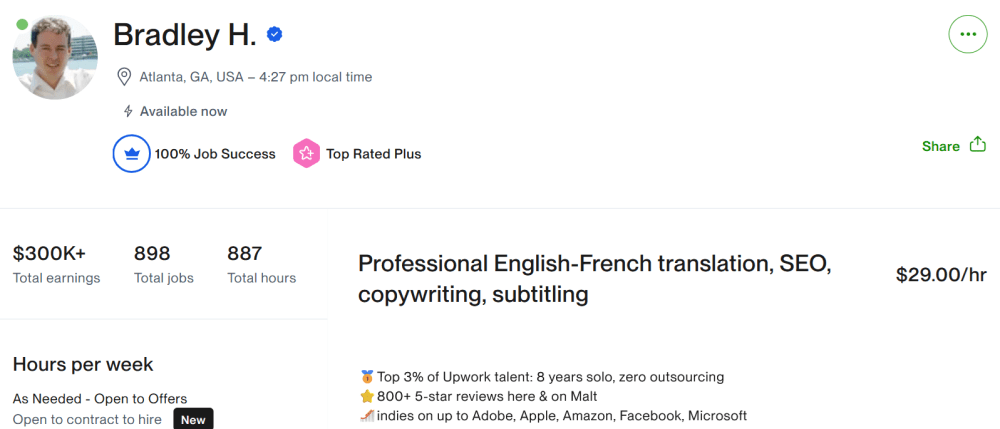
You're here for authentic, consistent, and captivating HUMAN content. I faithfully convey cultural nuances and nimbly, NATURALLY tailor your message for your audience (IDIOMS, MEANING, and IDEAS—ZERO awkward, word-for-word machine drivel). Count on fast, friendly help from this veteran independent freelancer. A lifelong bilingual with an MA in linguistics, I'm also keenly familiar with various French cultural intricacies having studied, worked, traveled, married, and raised a child in France, Gabon (Africa), and Canada.
You'll find vast experience here with Canadian French, European French, U.S. English and content that I've painstakingly researched and written over the years: marketing, financial, technical, training, legal, environmental, health, medical, sports, gambling, and more.
Read my reviews, and send me a direct message for a FREE consultation—en français, ou bien in English!💥
𝗦𝗲𝗿𝘃𝗶𝗰𝗲𝘀 𝗜 𝗼𝗳𝗳𝗲𝗿:
✍️authentic copywriting and organic SEO blog articles that your audience AND search engines love (search intent, keyword research, natural on-page SEO with optimized meta/header/alt tags and the right mix of internal/external links to boost organic traffic)
📊optimization within Google Natural Language API and other tools💬strategic B2B/B2C content, sales funnels, email/social media campaigns 🎨expert layout and formatting (PDF, Word, Excel, PowerPoint/Slides presentations, InDesign, Google Docs, Wix, WordPress, Hubspot, Canva, Figma)
⚖️consistent, compliant contracts, terms and conditions, privacy policies, paralegal drafting
📦consistent, compliant packaging
💻SaaS, apps and data (po, json, HTML, and other formats; code meticulously preserved)
🎮natural video game localization, quality assurance
🎥FLAWLESS subtitles, compliant captions—MANUALLY written, formatted, synced line by line: clean, precise format of your choice (VAST experience with movies, documentaries, webinars, educational videos, marketing, YouTube, Vimeo, more)
🎙️impeccably written and formatted transcriptions with timestamps for focus groups, surveys, market studies
🎤live interpreting and consultation via Zoom, Teams, other platforms
🤫total confidentiality, NDA, certification on request
🚀deadlines NEVER missed, NEVER pressed for payment (let's ensure perfect results first!) ❣corrections/suggestions to source text in tracking mode/comments as I work
🚫ZERO machine/AI slop
𝗠𝘆 𝗲𝘅𝗽𝗲𝗿𝗶𝗲𝗻𝗰𝗲:
✔️translation, focus group, market research for Foot Locker, Nike, Rolex, Facebook, Nestlé, Canadian Tire, Mayo Clinic
✔️translation, subtitles, transcription of marketing material for Amazon, Boucheron, Lillet, Vogue, Ivanti, Intel, Oculus Rift
✔️bilingual educational content for Wayside Publishing, Duolingo, Wlingua; marketing/website content for LMS Absorb
✔️major development/gender and reproductive rights/NGO projects across the African continent
✔️film and documentary subtitles (pour les Québecois, c'est tiguidou, là)
✔️complex technical and medical manuals: Worldcoin, crypto, Lyft, Pedego...
ET ENFIN, pour mes futurs clients francophones, c'est OUIII ! Nous pouvons également communiquer en français à tout moment — c'est comme vous voulez ! Ancien bourlingueur ayant séjourné en France, au Gabon, et au Canada, journaliste de sept ans devenu linguiste et professeur de langues à la fac depuis 20 ans, je vous propose du contenu naturel à valeur ajoutée — adapté à chaque public — pour des tarifs très raisonnables établis sur nombre de mots ou minutes vidéo. Merci de tenir compte de notre décalage horaire, et à très vite !
𝗧𝗲𝘀𝘁𝗶𝗺𝗼𝗻𝗶𝗮𝗹𝘀:
"Brad's versatility as a translator is one-of-a-kind. From the technical language in our film to creative wordplay, he found a way to purvey everything into French even when it didn't have exact cultural equivalents abroad. There was one pun in particular for which we'd spent weeks trying to find a translation. Brad quickly came up with a brilliant solution (Trisomique ? C'est chic !)"
—Michael McDonald, Broccoli Film Initiative
"Brad delivered high-quality, consistent, and client-ready translations for everything from PowerPoint decks to simulation exercise materials to trainee communications. He often provided added value with suggestions for clarity. Given the highly technical content and high standards for training organizers (WHO, US CDC, GAVI, UNICEF) and the quick turnarounds on materials, we truly couldn't have gotten it all done without Brad’s expertise and support."
—GAVI, The Vaccine Alliance
"Juste parfait, que ce soit en délai ou en qualité."

 Member since Jul '26


 Portfolio